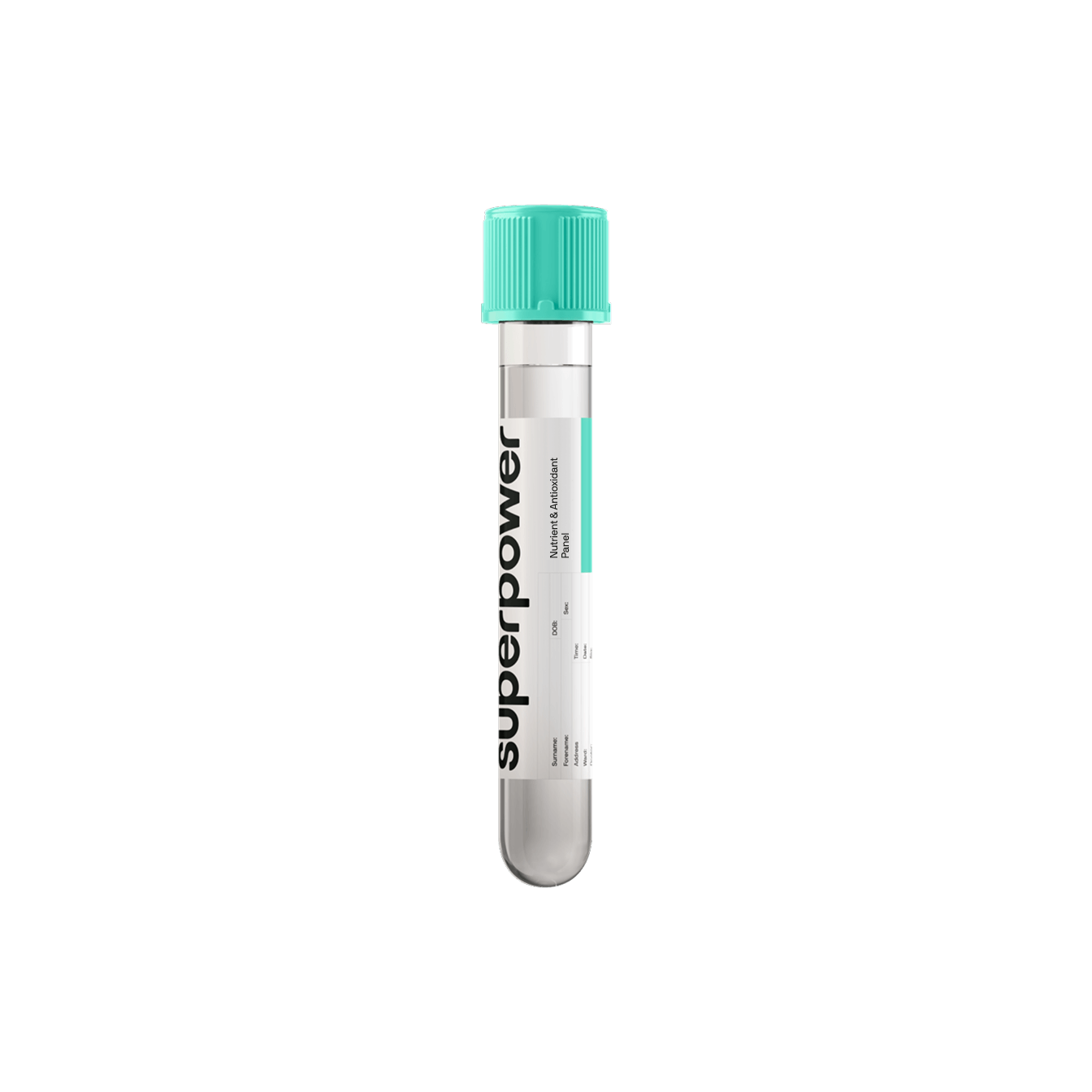
Test details
- Sample type:
- Single blood draw (blood only)
- Location:
- In-person at Quest Diagnostics / At-home phlebotomist visit (+$119)
- Availability:
- Available in 39 states and Washington, D.C.
- Turnaround:
- Results delivered to your dashboard within 10 days
- Preparation:
- Fast for 10 hours before your draw, water onlyPause vitamin and mineral supplements for 72 hoursContinue prescribed medications
About the Nutrition Bundle
The Nutrition Bundle is a blood panel that measures 11 vitamin, mineral, and methylation biomarkers from a single draw. It covers the nutrients standard bloodwork tends to leave out, alongside the functional markers that show how your body is using them. One sample, taken in-lab or through an at-home draw.
Three panels sit inside it: the Methylation Panel, Vitamin Levels, and Mineral Levels. Ordered separately, that is three decisions and three draws. Ordered as a bundle, it is one draw and one set of results read side by side.
What this panel measures
The markers fall into three groups: vitamins, minerals, and the methylation and functional markers read alongside them.
| Marker | What it reflects |
|---|---|
| Vitamin B12 | Red blood cell maturation, neural function, and DNA synthesis |
| Folate (Folic Acid) | Red blood cell maturation and methionine synthesis, measured in serum, where it is sensitive to recent dietary intake |
| Vitamin B6 | A cofactor in nitrogen, amino acid, and fatty acid metabolism |
| Vitamin C | Collagen formation, wound healing, and bone and blood vessel health |
| Magnesium RBC | Magnesium measured inside red blood cells, because most body magnesium sits inside cells or in bone |
| Selenium | A component of glutathione peroxidase and thyroid hormone iodinase |
| Zinc | An enzyme component with roles in skin integrity, wound healing, and growth |
| Homocysteine | A metabolite that rises as vitamin B12 status declines, and also moves with folate status and kidney function |
| Methylmalonic Acid | The most sensitive marker of vitamin B12 status |
| RBC Folate | Folate inside red blood cells, a longer-term measure of folate intake |
Two markers describe how a pathway is running rather than how much of a nutrient is present.
Why this panel reads function, not just levels
This is a blood panel: it returns measurements. A nutrient result may indicate where your intake and absorption are landing. It does not establish what is causing a symptom. Your Superpower care team and your provider read it alongside the rest of your picture.
A level answers how much of a nutrient sits in the sample drawn. A functional marker answers something else. Homocysteine and methylmalonic acid (MMA) are metabolites that accumulate when the B-vitamin pathway they depend on slows down. Total plasma homocysteine rises as vitamin B12 status declines, and it also moves with folate status and kidney function.
Two markers are read inside red blood cells for a related reason. Most magnesium in the body sits inside cells or in bone, and serum magnesium correlates poorly with total body magnesium. Serum folate is sensitive to recent dietary intake, while red blood cell folate (RBC folate) covers a longer window. No approach settles a nutrient on its own, and for magnesium no single method is considered satisfactory. Vitamin B12 is where that limit shows most often.
What a normal B12 result can still miss
A vitamin B12 result sitting inside the laboratory's range does not settle B12 status on its own. Serum or plasma vitamin B12 is the level routinely measured, and the cutoff used varies by method and laboratory. In range means in range for that assay, on that day.
Methylmalonic acid is what the panel adds to that reading. It is the most sensitive marker of vitamin B12 status. That matters most when a serum B12 result sits in the middle band rather than clearly low. MMA also rises with reduced kidney function and tends to be higher in older adults. A clinician reads the two numbers together rather than scoring one against the other. Who gains most from that pairing depends on why you are testing.
Who benefits from testing
These are situations where the measurements are useful to have. None is a diagnosis, and none is a reason to change a supplement or medication on your own.
- Fatigue, poor sleep, or recovery that lags your training — Common reasons people ask about nutrient status, with many possible causes behind them.
- A restricted or plant-based eating pattern — People following vegetarian patterns are among the groups more likely to be low in vitamin B12.
- Ongoing supplementation — Seeing where the measured levels actually sit rather than assuming a dose is landing.
- A digestive condition, prior gastrointestinal surgery, or long-term metformin or proton pump inhibitor use — Each is associated with lower vitamin B12 status.
- A broader results picture — Nutrient and methylation markers added to what you already track.
In every case, what comes back is a set of specific numbers rather than a verdict.
What your results reveal
Your report shows each vitamin and mineral measured against the laboratory's reference range, with the functional markers read beside them. Every line names its specimen: red blood cell, serum, or plasma. The specimen changes what the number describes.
The reading worth having is whether the functional markers agree with the levels. Homocysteine and methylmalonic acid move with how the pathway is running, and RBC folate covers a longer window than serum folate does. Results can also show a nutrient sitting above its range, not only below it.
These are specific numbers for your care team and your provider to interpret. An out-of-range value may indicate where to look, but it does not by itself explain a symptom.
Reference ranges vary by lab and individual. Your Superpower care team and your provider will interpret your specific results in context.
How to prepare
A few things in the days before the draw keep your numbers clean.
- Fast for 10 hours beforehand, water only.
- Skip caffeine, and avoid alcohol and heavy, fatty meals the day before.
- Hydrate well the day before.
- Pause supplements for 72 hours, vitamins and minerals included, since a serum level such as folate is sensitive to recent dietary intake.
- Keep taking prescription medications unless the prescribing clinician advises otherwise, and ask your care team to reconcile a prescribed supplement before you change it.
- Skip strenuous exercise for 48 hours beforehand.
- Reschedule if you are unwell with a cold, flu, or fever.
With those settled, the draw itself is a short appointment.
How it works
- Order online — No referral needed, and a qualified provider reviews the order as part of the process.
- Give your sample — A single blood draw at a local lab, or an at-home phlebotomist visit.
- Read your results — Your results typically appear in the Superpower dashboard about 10 days after the draw, once the panel is finalized.
Frequently asked questions
Biomarkers tested
Vitamin B12 (cobalamin) is a water-soluble vitamin that plays a central role in energy production, DNA synthesis, red blood cell formation, and nervous system health.
Learn moreMethod: FDA-cleared clinical laboratory assay performed in CLIA-certified, CAP-accredited laboratories. Used to aid clinician-directed evaluation and monitoring. Not a stand-alone diagnosis.




















 Heart & Vascular Health
 Metabolic Health
 Energy
 Liver Health
 Kidney
 Sex Hormones
 Thyroid Health
 Nutrients
 Immune System
 Inflammation