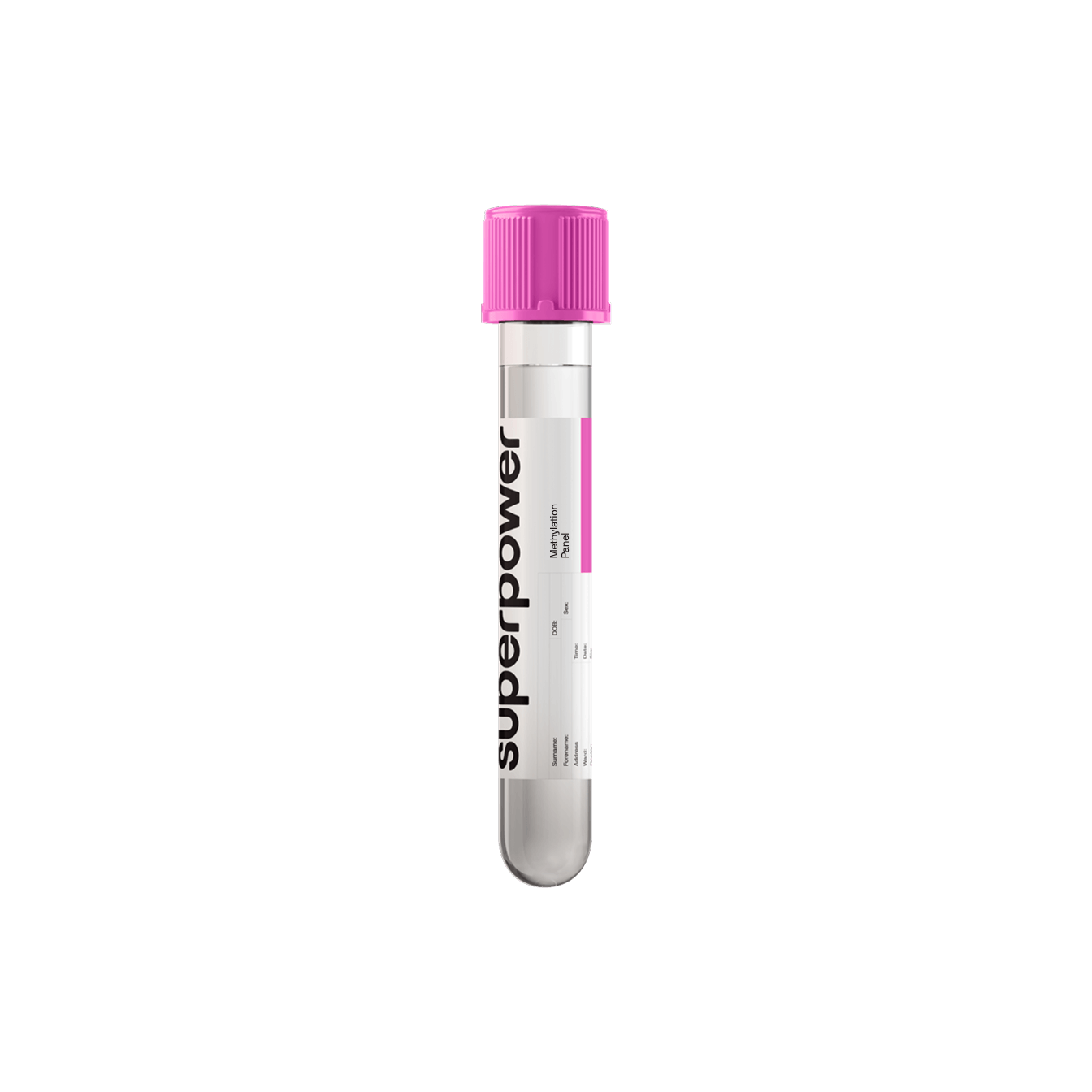
Test details
- Sample type:
- Blood draw (blood only)
- Location:
- In-person at Quest Diagnostics
- Availability:
- Available in 39 states and Washington, D.C.
- Preparation:
- Your care team will share prep steps when you book
About the Methylation Panel
Your energy, mood, and long-term health all depend on a process most blood tests never check: methylation. Whether you arrived here searching for an MTHFR test, a homocysteine blood test, or answers to unexplained fatigue and brain fog, this panel measures what's actually happening in your methylation cycle right now, across a focused set of functional markers, with no doctor's visit required.
Understanding methylation
Methylation is a biochemical process that happens billions of times per second in every cell of your body. It's involved in producing neurotransmitters (affecting mood and cognition), supporting DNA repair, detoxifying harmful compounds (affecting inflammation), and converting food into energy. When methylation slows down, the effects can show up everywhere: mood, energy, cardiovascular health, and detox capacity. This panel measures functional blood markers, not genes. It reveals where the cycle may be stalling and which B vitamins are falling short, including tests that catch deficiencies standard bloodwork can miss. Homocysteine is the most recognizable of these markers.
What the panel tests
Homocysteine
Homocysteine is an amino acid produced during the metabolism of methionine. In a healthy methylation cycle, it's efficiently converted back to methionine or onward to cystathionine, a process that requires B12, folate, and B6 as cofactors. When these vitamins are insufficient or MTHFR enzyme activity is reduced, homocysteine can accumulate. Elevated homocysteine is associated with increased cardiovascular risk, and it's one of the most directly modifiable markers on this panel, since B-vitamin status has a measurable effect on it. It's worth discussing any elevated result with your provider.
Vitamin B12 (Cobalamin)
Vitamin B12 is essential for converting homocysteine back to methionine, and it supports neurological function, red blood cell formation, and DNA synthesis. Deficiency can raise homocysteine and is more common than many people assume. Risk groups include vegans, vegetarians, people taking metformin, and older adults with reduced stomach acid. Serum B12 can appear within range even when a functional deficiency exists at the cellular level, which is why pairing it with MMA (below) adds important context.
Methylmalonic Acid (MMA)
MMA is a more sensitive functional marker of B12 status than serum B12 alone. When B12 is genuinely deficient at the cellular level, MMA tends to accumulate, even when serum B12 appears within the reference range. Testing MMA alongside B12 may help reveal a functional B12 deficiency that serum B12 alone may not reflect, which is a meaningful upgrade over standard B12 testing. Most basic vitamin panels don't include MMA, making it a key differentiator of this panel.
Vitamin B6
Vitamin B6 participates in the transsulfuration pathway, the step where homocysteine is converted to cystathionine. When B6 is insufficient, this step can slow and homocysteine may accumulate. B6 is also required for the synthesis of serotonin and dopamine, which makes it relevant to mood and cognitive function. Measuring B6 alongside the other methylation markers gives a clearer picture of whether the cycle has the cofactors it needs to run efficiently.
RBC Folate
Folate, in its active 5-methyl form, supplies the methyl group used to convert homocysteine back to methionine. The MTHFR enzyme generates that active folate form, so reduced MTHFR activity can lower the supply. RBC (red blood cell) folate reflects long-term folate status over roughly 2-3 months, a more stable and accurate measure than serum folate, which can fluctuate with recent meals. Low RBC folate is associated with elevated homocysteine and is also affected by MTHFR gene variants that reduce the efficiency of folate conversion. This is a functional blood measurement, not a genetic test.
Methylation and MTHFR: the difference
The MTHFR gene encodes an enzyme involved in folate metabolism and methylation. Genetic variants in this gene affect roughly 40% of the population and can impair methylation efficiency. A genetic MTHFR test looks for those DNA variants. It tells you whether you carry the variant, but not whether it's actually affecting your methylation right now. This panel takes a different approach: it measures functional blood markers (homocysteine, B12, MMA, B6, and RBC folate) that show what's actually happening in your methylation cycle today, regardless of your genetic makeup. Those markers are shaped by genetics, but also by diet, lifestyle, and medication. Both types of testing have value: genetic MTHFR testing speaks to predisposition, while this panel speaks to current function. If you've been searching for an MTHFR test, this panel offers the functional context that genetics alone can't.
Symptoms worth investigating
Methylation testing may offer useful context if any of these apply to you:
- Persistent fatigue or low energy
- Brain fog or difficulty concentrating
- Mood instability, low mood, or anxiety
- Poor sleep
- Cardiovascular risk factors flagged on prior bloodwork
- A history of miscarriage or pregnancy complications
- A vegan or vegetarian diet
- Use of metformin, proton pump inhibitors, or oral contraceptives
- A family history of cardiovascular disease or stroke
Who benefits from testing
- You have a known MTHFR gene variant, which affects roughly 40% of the population and can impair methylation
- You've had elevated homocysteine on previous testing
- You have fatigue, brain fog, mood issues, or cardiovascular concerns that haven't been fully explained
- You have a family history of heart disease, stroke, or neurological conditions
- You want to understand whether your body is efficiently running one of its most fundamental processes
- You follow a vegan or vegetarian diet, which raises the risk of B12 and folate shortfalls
- You take metformin, which can impair B12 absorption
- You're planning a pregnancy or have a history of pregnancy loss
How to prepare
Your Superpower care team will share any preparation steps when you book your draw.
How it works
- Order online — No doctor's visit required.
- Get your blood drawn — Visit a local clinic.
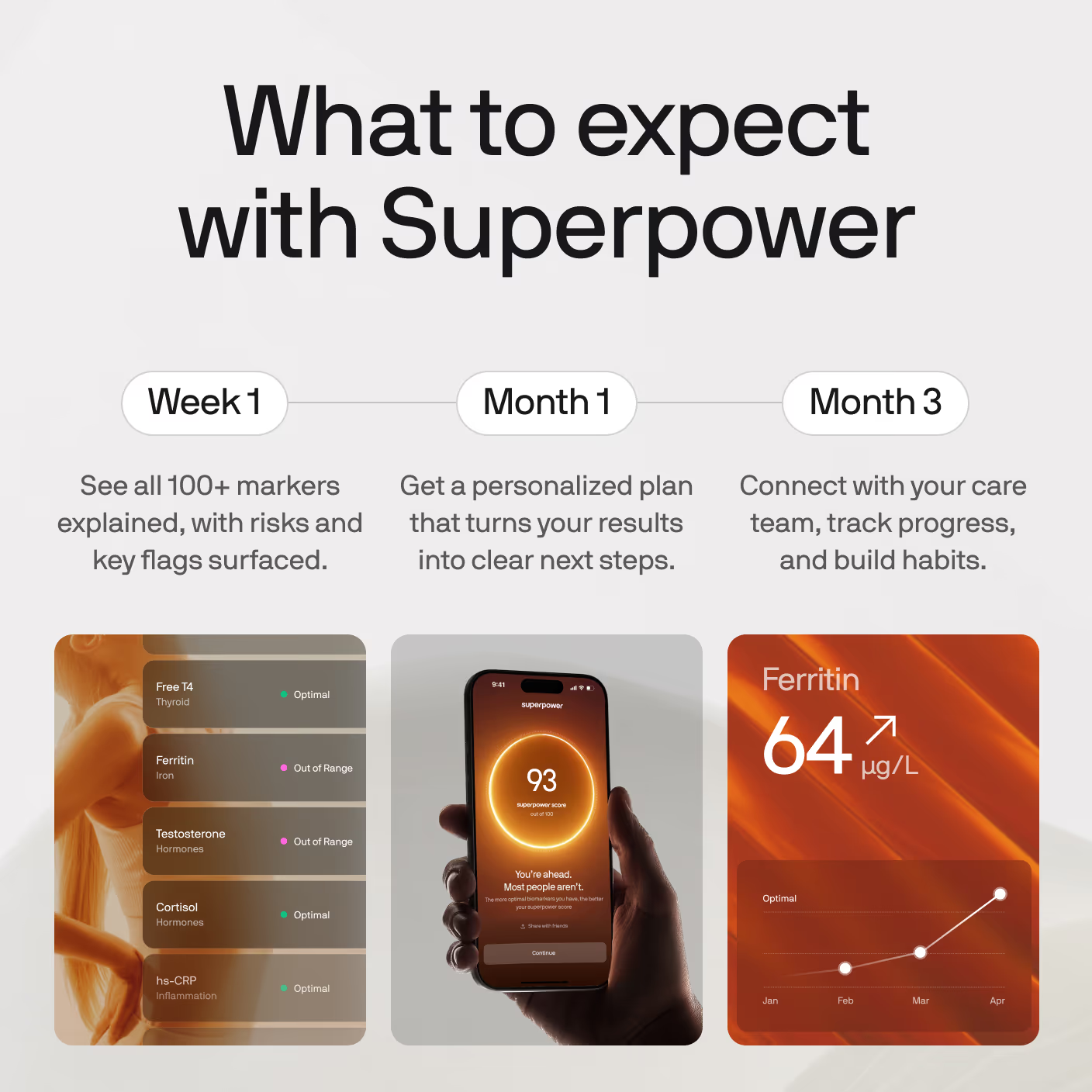
- Review your results — Your results arrive in your Superpower dashboard, and your care team is available to walk through what each marker means.
What your results reveal
Your results show whether your methylation cycle is running well or stalling, and where the cycle may be falling short. That's the difference between "take a B-complex" and a clearer picture you and your provider can use to decide on next steps. Every marker is shown with your measured value and a reference range, and they're most meaningful read as a system: a low B12 with a high MMA tells a different story than a low B12 with a normal MMA. Your Superpower care team and your provider can help you interpret the full picture together.
Reference ranges vary by lab and individual. Your Superpower care team and your provider will interpret your specific results in context.
Frequently asked questions
Biomarkers tested
Vitamin B12 (cobalamin) is a water-soluble vitamin that plays a central role in energy production, DNA synthesis, red blood cell formation, and nervous system health.
Learn moreMethod: FDA-cleared clinical laboratory assay performed in CLIA-certified, CAP-accredited laboratories. Used to aid clinician-directed evaluation and monitoring. Not a stand-alone diagnosis.





















 Heart & Vascular Health
 Metabolic Health
 Energy
 Liver Health
 Kidney
 Sex Hormones
 Thyroid Health
 Nutrients
 Immune System
 Inflammation