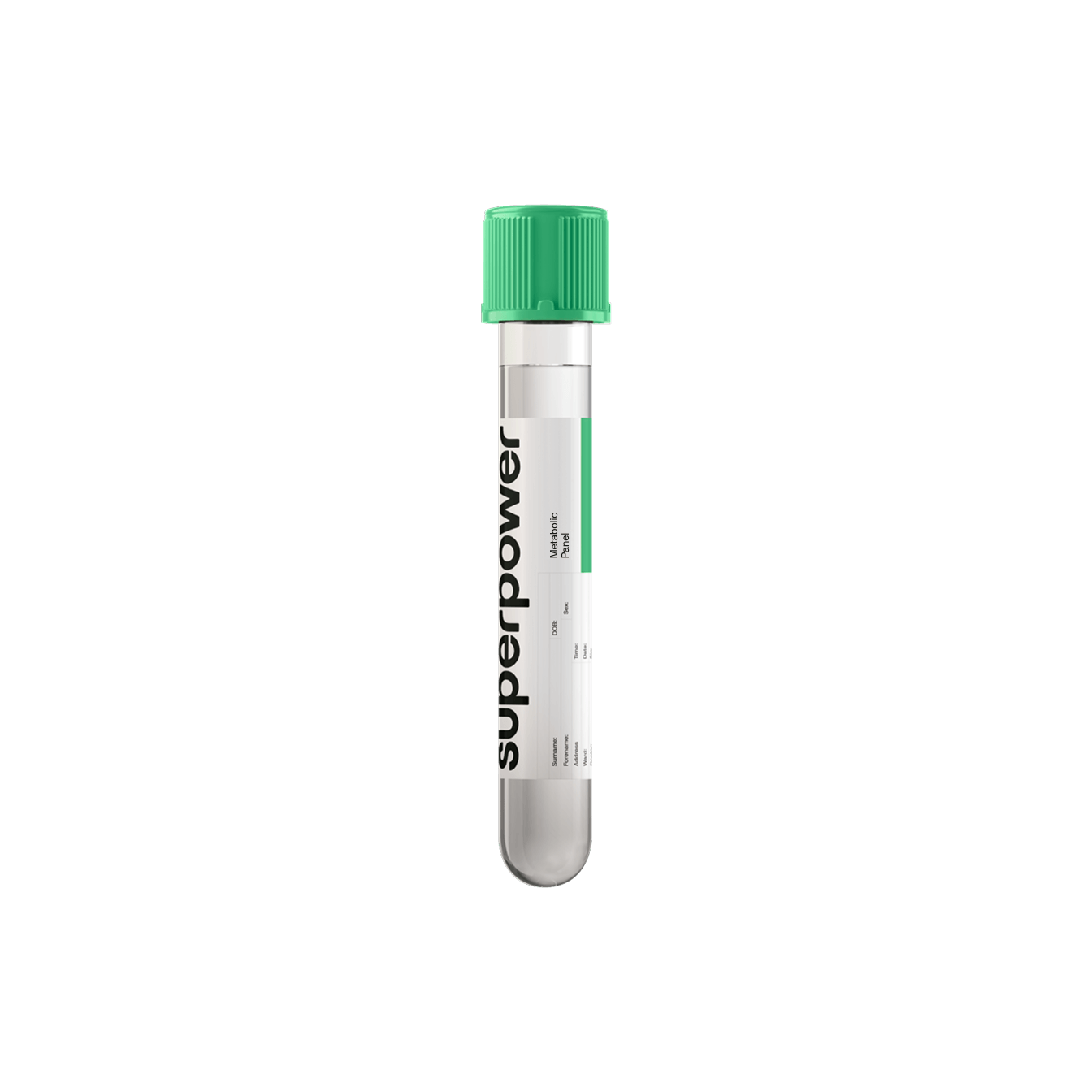
Test details
- Sample type:
- Single blood draw (blood only)
- Location:
- In-person at local lab / At-home phlebotomist visit (+$119)
- Availability:
- Available in 39 states and Washington, D.C.
- Turnaround:
- Results ready within 10 days
- Preparation:
- Fast for 10 hours before your draw (water only, no caffeine)Pause supplements for 72 hours and strenuous exercise for 48 hours
About the Extended Metabolic Bundle
The Extended Metabolic Bundle is an add-on blood panel: a set of biomarkers that layer onto a baseline blood panel rather than standing in place of one. That baseline is the broad draw covering your standard annual numbers. From a single blood draw, this bundle covers insulin production, recent glucose exposure, and the fat-cell hormone involved in appetite.
It is built for an adult who has already booked a metabolic blood test, or is about to, and wants the hormone layer underneath those numbers measured too. Fasting glucose and A1c describe where blood sugar sits. These advanced metabolic markers describe the system holding it there.
What this panel measures
The Extended Metabolic Bundle measures biomarkers from two smaller panels: one for glucose regulation, one for weight and appetite hormones.
| Marker | What it reflects |
|---|---|
| C-peptide | Released as your body makes insulin, in equal amounts with insulin, so it tracks how much insulin your pancreas is producing. |
| Fructosamine | Average glucose levels over about 3 weeks, a much shorter window than A1c. |
| Leptin | A hormone body fat releases that regulates hunger and provides the sensation of satiety. |
Those markers are not what most people picture when they hear the phrase metabolic panel.
An add-on panel, not a comprehensive metabolic panel
A comprehensive metabolic panel is a different test entirely. It is a routine blood test that measures 14 substances, among them electrolytes, liver enzymes, and the kidney waste products BUN and creatinine. That panel describes how your organs are handling the basics. This bundle measures hormonal and glucose-handling biomarkers instead, so the two answer different questions.
It is also an add-on rather than a replacement. It sits alongside a baseline blood panel, and it does not itself include glucose, insulin, HbA1c, or a glucose tolerance test. Those numbers belong to the panel underneath this one.
What these biomarkers add is a different timescale and a different question about the same system.
What these markers add to fasting glucose and A1c
A1c and fructosamine both describe average glucose, over different stretches of time. An A1c result reflects average blood glucose over the past 3 months, while fructosamine covers roughly the past three weeks. A change you made recently, in food, in training, or in a prescribed medicine, reaches the shorter window first.
A glucose value says where blood sugar sat on the morning of the draw. C-peptide says how much insulin your pancreas made to hold it there, because C-peptide enters the bloodstream with insulin and is unaffected by outside sources of insulin.
Leptin then adds a layer neither glucose nor A1c carries. It circulates at a level directly related to how much body fat you have. Which of those layers matters most depends on why you are testing.
Who benefits from testing
The hormone layer earns its place once fasting glucose or A1c has been measured and the question runs past what those two answer.
- You already track fasting glucose or A1c and want a read on about 3 weeks of glucose rather than three months.
- You are working on body composition or appetite and want the fat-cell hormone that regulates hunger and fullness measured.
- Metabolic disease runs in your family and you want a measure of how much insulin the body is making on its own.
- You have recently changed your diet, your training, or a prescribed medicine and want to see whether recent glucose exposure has moved with it.
- You have a baseline blood panel already and want to build on those results rather than repeat them.
What any of it means for you is a conversation with your care team and your provider, who can read the numbers together.
What your results reveal
Your report gives a measured value for each biomarker beside a reference range. C-peptide inside that range, alongside glucose in range, is consistent with a pancreas producing a typical amount of insulin. Fructosamine in range indicates that average glucose over about 3 weeks sat where expected.
A result outside the range is information rather than a diagnosis. A high C-peptide usually means the body is making too much insulin. Leptin running high alongside persistent hunger is the pattern described as leptin resistance, which is linked with obesity.
Reference ranges vary by lab and individual. Your Superpower care team and your provider can help you interpret your specific results in context.
How to prepare
Preparation is the same as any fasting draw, and it starts the day before your appointment.
- Fast for 10 hours, water only.
- Skip caffeine before the draw.
- Hydrate well the night before and that morning.
- Avoid alcohol and heavy, fatty meals the day before.
- Avoid strenuous exercise for 48 hours beforehand.
- Pause supplements for 72 hours.
- Continue prescribed medicines unless the prescribing clinician advises otherwise.
Reschedule if you are unwell with a cold, flu, or fever. Take any question about a medicine, a supplement, or fasting to your care team.
How it works
- Order online — Add the Extended Metabolic Bundle to your Superpower membership, with no doctor's visit and no referral needed.
- Give a blood sample — A single draw at a local lab, or at home with a visiting phlebotomist.
- Review your results — They appear in your dashboard roughly 10 days after the draw, once every biomarker in the panel is complete. Your care team can walk you through them.
Frequently asked questions
Biomarkers tested
C-peptide is a short protein fragment released by the pancreas every time it makes insulin.
Learn more






















 Heart & Vascular Health
 Metabolic Health
 Energy
 Liver Health
 Kidney
 Sex Hormones
 Thyroid Health
 Nutrients
 Immune System
 Inflammation