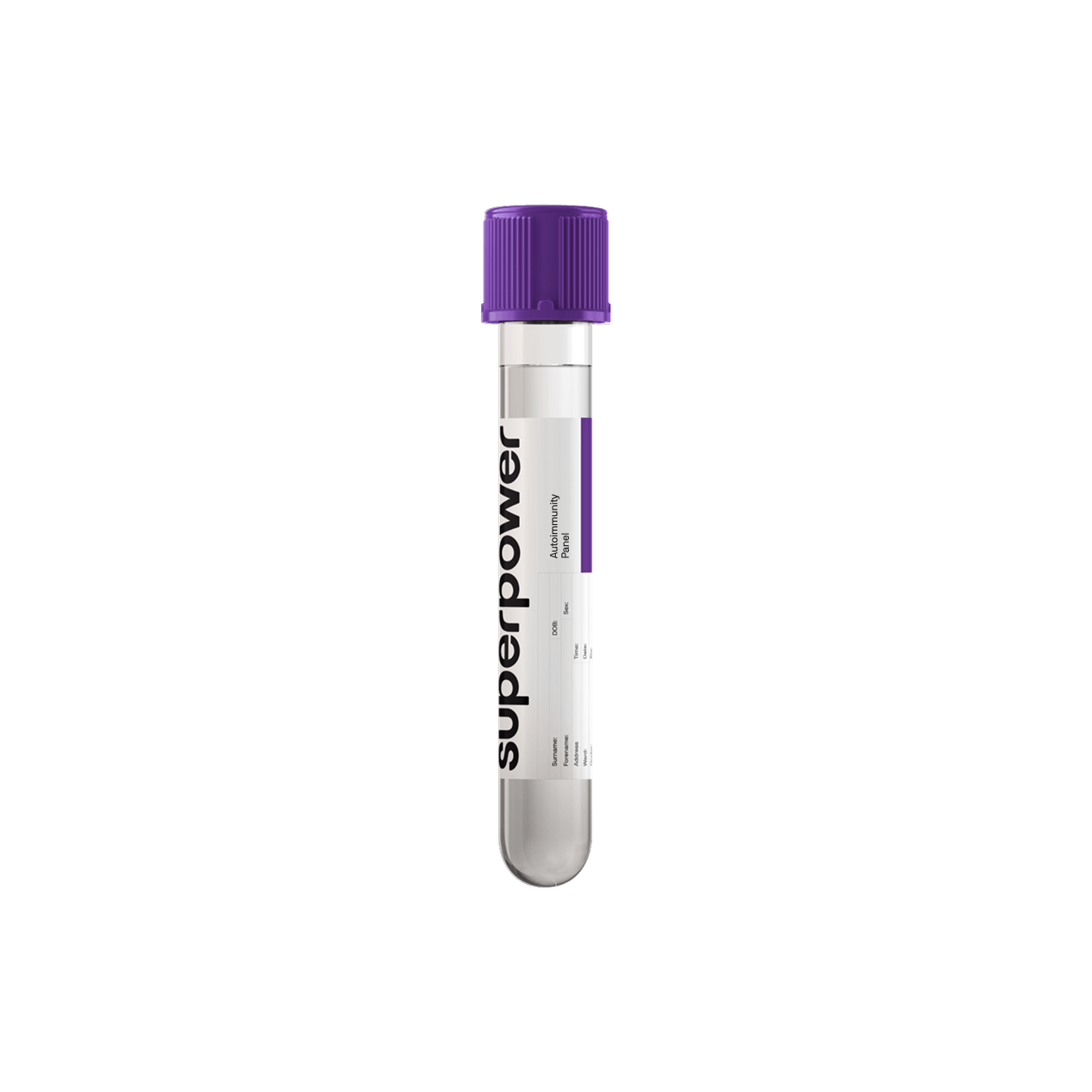
Test details
- Sample type:
- Single blood draw (blood only)
- Location:
- In-person at local lab / At-home phlebotomist visit (+$119)
- Availability:
- Available in 39 states and Washington, D.C.
- Turnaround:
- Results typically ready within 10 days
- Preparation:
- Fast for 10 hours before your draw, water onlyKeep eating gluten-containing foods until after your drawPause supplements for 72 hours beforehand
About the Autoimmune Health Bundle
The Autoimmune Health Bundle combines three screens in one blood draw: autoimmune and inflammation screening, celiac and gluten sensitivity, and thyroid autoimmunity. Together they measure selected antibodies and a marker of active inflammation.
Three screens sit in one product because the symptoms overlap. Joint stiffness, fatigue, digestive changes, and skin changes read much the same across many autoimmune conditions, so a single broad label is rarely what a person needs.
What the three screens put on your report is a set of named antibodies, not a general autoimmune score.
What this panel measures
The bundle groups its markers by the three screens it combines, and each antibody is reported individually rather than folded into one result.
| Screen | Markers included | What it reflects |
|---|---|---|
| Autoimmune and inflammation screening | Rheumatoid Arthritis Factor (RF); Cyclic Citrullinated Peptide Antibody (anti-CCP); Erythrocyte Sedimentation Rate | Antibodies associated with systemic autoimmune conditions and with rheumatoid arthritis, plus a general measure of whether inflammation is active |
| Celiac and gluten sensitivity | Tissue Transglutaminase Ab (tTG-IgA); Immunoglobulin A | The antibody associated with an immune response to gluten, and the total IgA that makes that antibody readable |
| Thyroid autoimmunity | Thyroid Peroxidase (TPO) Ab; Thyroglobulin Antibodies; Free T3 (Triiodothyronine) | Antibodies directed at thyroid tissue, alongside the active thyroid hormone in circulation |
Total IgA is measured alongside the celiac antibody because low total IgA can cause a false negative, a result that would otherwise read as reassurance.
The sedimentation rate reflects general inflammation rather than any one condition. Rheumatoid factor is measured alongside CCP antibodies, which are also found in people without rheumatoid arthritis.
Thyroid peroxidase and thyroglobulin antibodies are the two common markers of thyroid autoimmunity. Free T3 is the unbound form of the active hormone your body converts T4 into.
A named antibody on a report raises the harder question of what its presence actually means for you.
What an antibody result means, and what it does not
A positive antibody result means that antibody was detected in your blood. That turns an unexplained set of symptoms into a specific question a clinician can work with, which is most of its value. It is not a diagnosis, and no antibody on this panel supplies one on its own.
The distinction runs both ways. Some of these antibodies also turn up in people without the condition they are associated with.
A clinician weighs an antibody result against your symptoms, an examination, and any further testing before anything is named. Your Superpower care team is available to help you shape the questions worth bringing to your provider.
One of the three screens depends on what you have been eating in the weeks before the draw.
Gluten intake before celiac antibodies are measured
The celiac markers only read accurately while gluten is still part of your diet, because those antibodies are produced in response to eating it. Staying on a gluten-containing diet before the draw is what keeps the result readable, and cutting gluten beforehand can lower the antibody level the screen is looking for.
If you already avoid gluten, or you follow a diet a clinician put you on, talk the timing through with your care team before you change anything. Reintroducing gluten ahead of a draw is not a decision to make alone.
These markers measure an antibody response associated with gluten, and the bundle is not a general food-allergy or food-intolerance test.
Who benefits from testing
Antibody screening tends to come up in a handful of recognizable situations rather than as routine bloodwork. These are the ones people most often arrive with.
- Your labs came back normal, and antibodies were never part of the panel
- Autoimmune conditions run in your family, and you want to know where you stand
- Joint pain, fatigue, digestive changes, or skin changes have persisted without an explanation
- You already have one autoimmune condition identified and want the broader picture
Someone in one of those situations walks away with a list of named antibodies and an inflammation reading, measured on a single day.
What your results reveal
The Autoimmune Health Bundle reports each antibody it measures by name, across all three screens. The sedimentation rate sits alongside them as a read on whether inflammation is active at the time of the draw.
Timing is part of why antibodies get measured before anything is certain. In most people later diagnosed with systemic lupus erythematosus, at least one autoantibody was present a mean of 3.3 years before diagnosis, while they were still without symptoms.
A clean set across all three screens is a result too. It clears the explanations this bundle covers and moves the question elsewhere, though it does not close it alone. Your care team is available to talk it through either way.
Reference ranges vary by lab and individual. Your Superpower care team and your provider will interpret your specific results in context.
How to prepare
Preparation for this draw is about one thing: a clean sample that stays comparable to your next one.
- Fasting — 10 hours beforehand, water only
- Caffeine and alcohol — Skip caffeine, and avoid alcohol and heavy, fatty meals the day before
- Hydration — Keep drinking water normally through the fast
- Supplements — Paused for 72 hours before the draw
- Exercise — No strenuous exercise for 48 hours beforehand
- Prescribed medicines — Continue them unless the prescribing clinician advises otherwise, and send questions about a specific medicine or supplement to your care team
- Feeling unwell — A cold, flu, or fever before your draw is a reason to reschedule
With preparation settled, the remaining question is the sequence from ordering to results.
How it works
- Order online — The bundle is ordered as an add-on with an active membership, independently of baseline or retest scheduling.
- Give one sample — A single blood draw, in a lab or at home, covers all three screens.
- Review your results — The completed report appears in your Superpower dashboard with a notification, roughly 10 days after the draw. Partial results are not shown before the panel is finalized.
Your care team is available once the report lands, and your provider directs any clinical next steps.
Frequently asked questions
Biomarkers tested
Cyclic Citrullinated Peptide (CCP) antibodies are autoantibodies that target proteins in the body that have undergone a process called citrullination.
Learn more


















 Heart & Vascular Health
 Metabolic Health
 Energy
 Liver Health
 Kidney
 Sex Hormones
 Thyroid Health
 Nutrients
 Immune System
 Inflammation